Compliance Culture in Banking: The Trust, Risk Resilience, and Regulatory Confidence
Dhiren M | 30 Dec 2025 | 4 Feb 2026
In today’s banking environment, compliance failures are rarely caused by a lack of policies. They are caused by behavior, decision-making, and culture.
Despite billions spent on regulatory compliance, banks continue to face:
- AML and KYC failures
- Conduct risk violations
- Data privacy breaches
- Weak internal controls
Regulators are increasingly clear: a bank’s compliance posture is inseparable from its compliance culture.
A strong compliance culture ensures that rules are not just followed—but understood, internalized, and applied consistently across the organization. This article explores what compliance culture in banking means, why regulators care deeply about it, common challenges banks face, and how modern GRC platforms like Assurtiv help embed compliance into daily banking operations.
What Is Compliance Culture in Banking?
Compliance culture in banking refers to the shared values, attitudes, and behaviors that guide how employees identify, assess, and respond to regulatory obligations and ethical risks.
It is reflected in:
- How frontline staff handle customer onboarding
- How relationship managers manage conflicts of interest
- How compliance teams escalate issues
- How leadership responds to bad news
In banks with strong compliance culture:
- Employees act ethically even under pressure
- Speaking up is encouraged, not feared
- Compliance is viewed as a business enabler, not an obstacle
Why Compliance Culture Is Critical in Banking
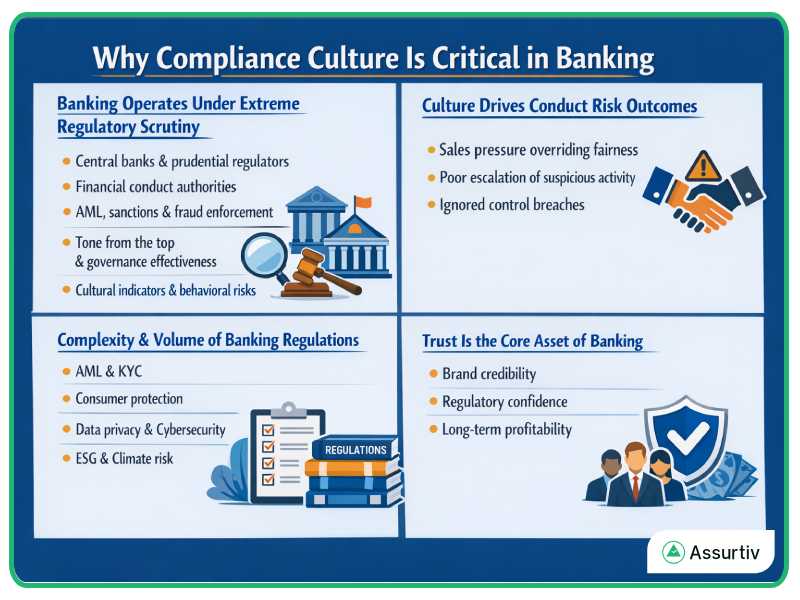
Banking Operates Under Extreme Regulatory Scrutiny
Banks are subject to oversight from:
- Central banks and prudential regulators
- Financial conduct authorities
- AML, sanctions, and fraud enforcement bodies
Regulators now evaluate:
- Tone from the top
- Governance effectiveness
- Cultural indicators and behavioral risks
A weak compliance culture often triggers deeper supervisory intervention—even when technical controls exist.
Culture Drives Conduct Risk Outcomes
Many banking enforcement actions stem from:
- Sales pressure overriding customer fairness
- Poor escalation of suspicious activity
- Ignored control breaches
These are not system failures alone—they are cultural failures.
A strong compliance culture reduces conduct risk by aligning incentives, ethics, and accountability.
Complexity and Volume of Banking Regulations
Banks must manage overlapping requirements across:
- AML and KYC
- Consumer protection
- Data privacy
- Cybersecurity
- ESG and climate risk disclosures
In this environment, employees frequently face gray areas. Culture guides decisions when rules are complex or unclear.
Trust Is the Core Asset of Banking
Banking is built on trust—from customers, investors, regulators, and markets.
Repeated compliance breaches erode:
- Brand credibility
- Regulatory confidence
- Long-term profitability
A strong compliance culture protects trust at scale.
Key Elements of a Strong Compliance Culture in Banking
Leadership Ownership and Accountability
Compliance culture starts with the board and senior management. Leaders must:
- Actively champion ethical behavior
- Support compliance decisions over short-term revenue
- Be accountable for failures within their business units
Without visible leadership commitment, compliance becomes symbolic rather than real.
Clear, Practical Compliance Policies
Banking policies should be:
- Risk-based and role-specific
- Written in plain language
- Integrated into business workflows
Overly complex or disconnected policies weaken frontline adoption.
Continuous, Role-Based Compliance Training
Effective banking compliance training:
- Goes beyond annual check-the-box sessions
- Is tailored to frontline, operations, and leadership roles
- Reinforces real-world scenarios (AML alerts, customer suitability, sanctions screening)
Training builds awareness—but culture ensures consistent application.
Strong Speak-Up and Escalation Mechanisms
Banks with healthy compliance cultures encourage employees to:
- Report concerns early
- Escalate issues without fear of retaliation
- Challenge unethical decisions
Silenced employees often precede major compliance failures.
Aligned Incentives and Performance Metrics
Compliance culture fails when:
- Sales targets conflict with compliance obligations
- Ethical behavior is not rewarded
- Violations are handled inconsistently
Banks must align compensation, performance reviews, and disciplinary actions with compliance values.
Common Challenges Banks Face in Building Compliance Culture
Despite regulatory pressure, many banks struggle with:
- Compliance perceived as a cost center
- Siloed risk, compliance, and audit teams
- Manual, fragmented compliance processes
- Limited visibility into cultural indicators
- Inconsistent enforcement across regions and lines of business
These challenges undermine even well-designed compliance frameworks.
Measuring Compliance Culture in Banking
Contrary to popular belief, compliance culture can be measured.
Banks increasingly track indicators such as:
- Training effectiveness and completion rates
- Policy acknowledgment and exceptions
- Incident and breach trends
- Whistleblowing volume and resolution times
- Audit findings and repeat issues
- Risk and compliance survey insights
Modern regulators expect evidence—not anecdotes—of cultural effectiveness.
How Assurtiv Strengthens Compliance Culture in Banking
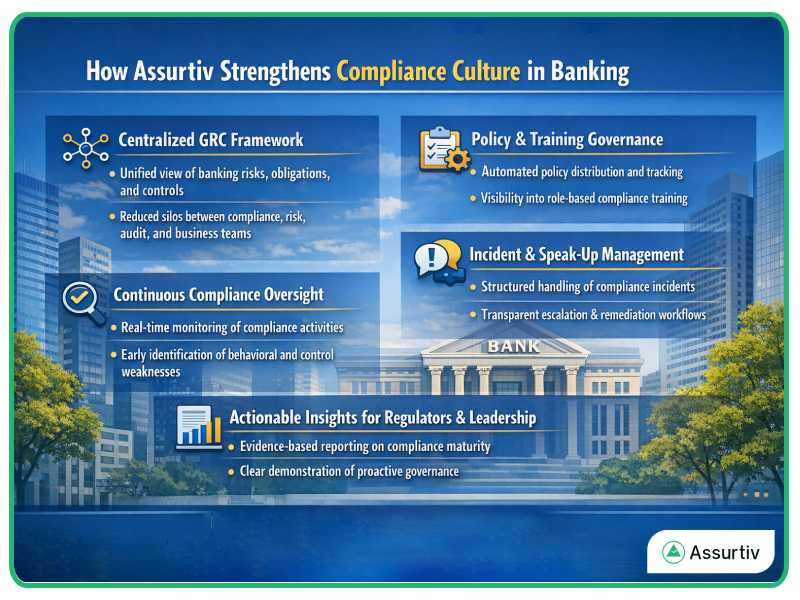 Assurtiv helps banks move from reactive compliance to culture-driven governance.
Centralized GRC Framework
- Unified view of banking risks, obligations, and controls
- Reduced silos between compliance, risk, audit, and business teams
Continuous Compliance Oversight
- Real-time monitoring of compliance activities
- Early identification of behavioral and control weaknesses
Policy and Training Governance
- Automated policy distribution and tracking
- Visibility into role-based compliance training effectiveness
Incident and Speak-Up Management
- Structured handling of compliance incidents
- Transparent escalation and remediation workflows
Actionable Insights for Regulators and Leadership
- Evidence-based reporting on compliance maturity
- Clear demonstration of proactive governance
With Assurtiv, banks can embed compliance into everyday decision-making—not just regulatory reporting.
Regulatory Expectations Are Shifting Toward Culture
Global banking regulators increasingly emphasize:
- Ethical leadership
- Behavioral risk management
- Culture-driven governance
Supervisory reviews now assess:
- How compliance issues are handled
- Whether employees feel safe to speak up
- How lessons learned are implemented
Banks that cannot demonstrate strong compliance culture face heightened scrutiny and enforcement risk.
The Future of Compliance Culture in Banking
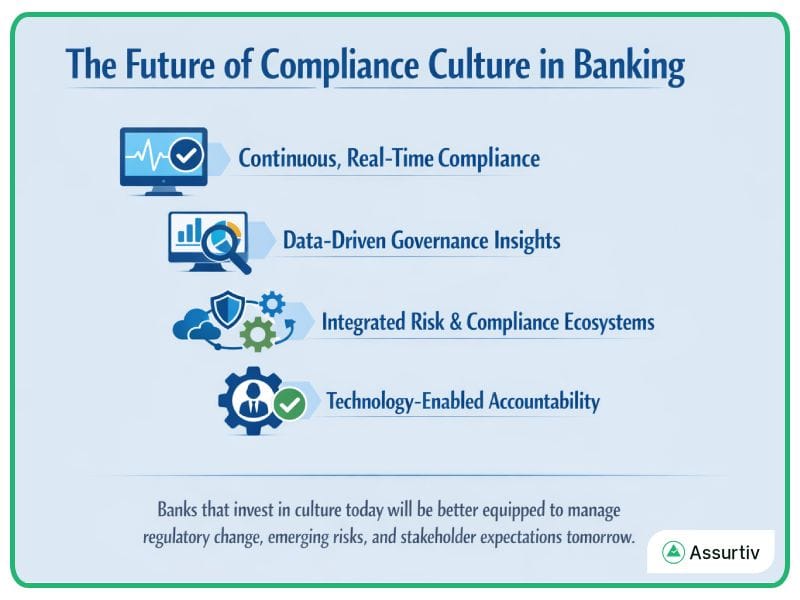 Compliance culture in banking is evolving toward:
- Continuous, real-time compliance
- Data-driven governance insights
- Integrated risk and compliance ecosystems
- Technology-enabled accountability
Banks that invest in culture today will be better equipped to manage regulatory change, emerging risks, and stakeholder expectations tomorrow.
Conclusion
In modern banking, compliance culture is not a soft concept—it is a core control.
Strong compliance culture:
- Reduces regulatory risk
- Enhances trust
- Improves decision-making
- Strengthens long-term resilience
With a modern GRC platform like Assurtiv, banks can transform compliance from a regulatory obligation into a strategic advantage.
Strengthen Your Bank’s Compliance Culture with Assurtiv
See how Assurtiv helps banks embed ethical behavior, continuous compliance, and regulator-ready governance across the organization.
Talk to our GRC experts today.