Data Privacy Trends & Risk Report 2026
Chakrapani KVC | 16 Jan 2026 | 17 Jan 2026
Data Privacy Day in 2026 arrives at a time when data has become both an organization’s greatest asset and its greatest liability. From stricter regulations and rising cyber threats to increasing customer expectations, privacy risk is no longer an IT issue alone. It is a board-level business priority.
This Data Privacy Trends & Risk Report explores the most critical shifts shaping the privacy landscape, highlights emerging risks, and provides actionable guidance for organizations preparing for the year ahead.
Why in 2026 Data Privacy Day Matters More Than Ever
Data Privacy Day, observed annually on 28 January, was created to raise awareness about the importance of protecting personal data. In 2026, its relevance has intensified due to:
- Expanding global privacy regulations
- Escalating data breach costs and penalties
- Growing third-party and AI-related privacy risks
- Heightened scrutiny from regulators, customers, and investors
Organizations that treat Data Privacy Day as more than a symbolic event, using it to assess readiness and strengthen controls gain a significant compliance and trust advantage.
Key Data Privacy Trends Defining 2026
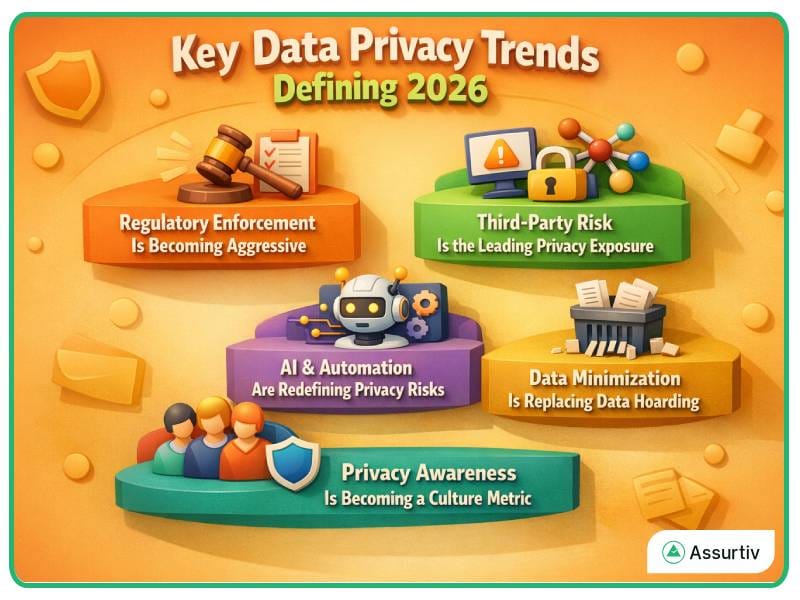
Regulatory Enforcement Is Becoming Aggressive
Privacy regulations are no longer “checkbox” exercises. Authorities are actively enforcing:
- GDPR with higher penalties for delayed breach reporting
- India’s DPDP Act with stronger accountability on data fiduciaries
- US state privacy laws with overlapping compliance requirements
Regulators are now focusing on evidence of implementation, not just written policies. Organizations must demonstrate operational compliance, not theoretical readiness.
Third-Party Risk Is the leading Privacy Exposure
Most data breaches today originate outside the organization, through vendors, cloud providers, and service partners.
Key risks include:
- Inadequate vendor privacy assessments
- Missing or outdated Data Processing Agreements (DPAs)
- Limited visibility into sub-processors
In 2026, regulators increasingly hold organizations accountable for their vendors’ failures, making third-party privacy risk management a critical focus area.
AI & Automation Are Redefining Privacy Risks
Artificial Intelligence introduces powerful capabilities but also new compliance challenges.
Common AI-related privacy risks include:
- Unclear data sources used for AI training
- Lack of transparency in automated decision-making
- Inadequate consent mechanisms
Organizations deploying AI tools must ensure privacy-by-design, robust documentation, and explain ability to meet regulatory expectations.
Data Minimization Is Replacing Data Hoarding
A major trend in 2026 is the shift from “collect everything” to collect only what is necessary.
Regulators are scrutinizing:
- Excessive data collection
- Indefinite data retention
- Poor data deletion practices
Data minimization not only reduces compliance risk but also limits breach of impact—making it a strategic risk-reduction approach.
Privacy Awareness Is Becoming a Culture Metric
Human error remains a leading cause of data incidents. In response, regulators are evaluating:
- Frequency of privacy training
- Employee awareness of breach reporting procedures
- Leadership involvement in privacy governance
Organizations with strong privacy culture programs experience fewer incidents and faster response times.
Top Data Privacy Risks Organizations Face in 2026
 Incident Response Delays
 Incident Response Delays
Many organizations still lack tested breach of response plans. Failure to notify regulators within mandated timelines (such as 72 hours under GDPR) results in severe penalties.
Incomplete Data Inventories
Without a centralized view of where personal data resides, organizations struggle to:
- Fulfill data subject rights
- Respond to audits
- Contain breaches
A comprehensive data inventory and mapping program is foundational to privacy compliance.
Policy Practice Gaps
One of the most common audit findings is the disconnect between documented policies and actual practices.
Examples include:
- Policies that aren’t enforced
- Manual processes prone to errors
- Controls that exist on paper but not in systems
Vendor Oversight Failures
Organizations often onboard vendors quickly without adequate privacy due diligence, creating long-term risk exposure.
How to Use This Data Privacy Day as a Strategic Reset
Rather than a symbolic celebration, Data Privacy Day 2026 should be used to measure, improve, and communicate privacy readiness.
Recommended Actions:
- Conduct a Data Privacy Readiness Assessment
- Review vendor privacy risk controls
- Test incident response and breach notification workflows
- Refresh privacy training programs
- Align privacy metrics with business risk reporting
Organizations that proactively act during Data Privacy Day demonstrate leadership, accountability, and resilience.
Privacy Metrics That Matter in 2026
Tracking the right privacy metrics helps organizations move from reactive compliance to proactive risk management.
Key metrics include:
- Number of unresolved privacy risks
- Vendor risk assessment coverage
- Time to detect and respond to incidents
- Training completion and awareness levels
- Audit findings closure rate
These metrics also support board-level reporting and regulatory readiness.
A Privacy First Operating Model for the Future
In 2026 and beyond, privacy success depends on integration, not isolation.
Leading organizations are embedding privacy into:
- Product development
- Vendor onboarding
- Enterprise risk management
- Governance, Risk & Compliance (GRC) programs
This integrated approach enables scalability, reduces manual errors, and strengthens long-term compliance maturity.
Turning The Data Privacy Day into Competitive Advantage
This time Data Privacy Day is more than a reminder—it’s a call to action.
Organizations that treat privacy as a strategic priority will:
- Reduce regulatory and breach risks
- Build lasting customer trust
- Strengthen brand credibility
- Enable sustainable digital growth
As data continues to power innovation, privacy will define trust. The time to act is now.
Ready to Assess Your Privacy Readiness?
Use 2026 Data Privacy Day to understand where your organization stands and where it needs to improve.
Start with a Data Privacy Readiness Assessment
Identify gaps before regulators or attackers do