DPDP Act Violation Penalties Framework
Dhiren M | 27 Feb 2026 | 26 Feb 2026
India’s Digital Personal Data Protection (DPDP) Act introduces one of the most stringent penalty regimes in the country’s regulatory history. Effective from 13 May 2027, the law significantly raises the stakes for organizations handling personal data. Unlike earlier frameworks that focused primarily on compliance advisories, the DPDP Act establishes a structured and financially consequential violation of penalties framework designed to drive accountability at scale.
For managing boards, CXOs, compliance heads, and risk leaders, the conversation is no longer limited to privacy documentation. It now centers on financial exposure, governance oversight, operational preparedness, and regulatory defensibility.
With penalties reaching up to ₹250 crore for certain violations, organizations must move from reactive compliance to proactive data governance. Understanding the DPDP Act violation penalties framework is essential for safeguarding business continuity, reputation, and long-term growth.
Overview of the DPDP Act Penalties Framework

The DPDP Act introduces a structured financial penalty model applicable to organizations classified as Data Fiduciaries, including Significant Data Fiduciaries (SDFs).
The penalties are tiered based on the severity and nature of the violation. The most critical categories include:
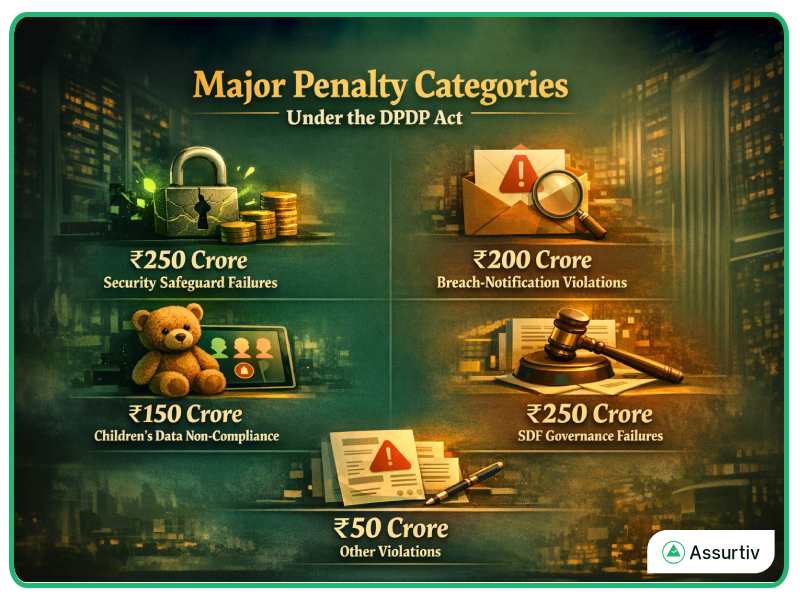
- ₹250 Crore for failure to implement adequate security safeguards
- ₹200 Crore for breach-notification violations
- ₹150 Crore for non-compliance related to children’s data
- ₹250 Crore for Significant Data Fiduciary governance failures
- ₹50 Crore for other violations
These figures represent maximum penalty ceilings, but even partial enforcement could materially impact financial performance and investor confidence.
Why the DPDP Act Violation Penalties Framework Is Significant
India has historically relied on moderate financial sanctions in regulatory enforcement. The DPDP Act marks a structural shift toward deterrence through financial consequence.
For leadership, this signals:
- Stronger regulatory oversight
- Increased accountability at board level
- Greater personal liability exposure for governance failures
- Heightened scrutiny of cybersecurity posture
The magnitude of penalties places data protection alongside financial reporting and anti-corruption compliance in terms of risk priority.
Detailed Breakdown of Major Penalty Categories
₹250 Crore for Security Safeguard Failures
Failure to implement “reasonable security safeguards” can result in penalties up to ₹250 crore.
This includes:
- Weak cybersecurity controls
- Inadequate access management
- Poor encryption practices
- Lack of monitoring and logging
- Insufficient vendor security oversight
Security failures often trigger cascading consequences, including data breaches, reputational damage, and regulatory investigation. The DPDP Act reinforces that preventive security architecture is no longer optional.
₹200 Crore for Breach-Notification Violations
Timely breach of reporting is now a regulatory obligation.
Penalties up to ₹200 crore may apply if:
- Organizations delay notification to the Data Protection Board
- Individuals are not informed of data breaches
- Reporting is incomplete or misleading
Incident response planning and clear escalation protocols are critical to mitigating this exposure.
₹150 Crore for Children’s Data Non-Compliance
The Act introduces strict obligations around children’s data processing.
Violations may include:
- Failure to obtain verifiable parental consent
- Targeted advertising to minors
- Profiling children without lawful basis
Organizations operating in edtech, gaming, healthcare, and social platforms face heightened risk in this area.
₹250 Crore for Significant Data Fiduciary (SDF) Governance Failures
Organizations designated as Significant Data Fiduciaries must implement enhanced governance controls.
These may include:
- Appointment of a Data Protection Officer (DPO)
- Independent data audits
- Data Protection Impact Assessments (DPIAs)
- Formalized compliance monitoring
Failure in governance oversight can attract penalties up to ₹250 crore, reflecting the regulator’s focus on systemic accountability.
₹50 Crore for Other Violations
Other non-compliance areas—such as failure to respond to data principal rights or incomplete documentation—may attract penalties up to ₹50 crore.
Although lower than headline figures, these penalties remain financially significant.
Strategic Implications for Managing Boards and CXOs
The DPDP Act violation penalties framework directly impacts enterprise risk strategy.
Key leadership considerations include:
- Is data protection integrated into enterprise risk management?
- Does the board receive regular cybersecurity and compliance reporting?
- Are breach response plans tested and documented?
- Is vendor data risk actively monitored?
Ignoring these questions could expose organizations to regulatory and reputational crises.
Governance & Risk Management Alignment
To mitigate exposure, organizations must align compliance with broader governance structures.
Strengthen Enterprise Risk Management Integration
Data protection should be embedded within enterprise risk management dashboards, with defined risk appetite thresholds and reporting mechanisms.
Enhance Cybersecurity Posture
Security safeguard failures represent the highest penalty category. Investment in threat detection, encryption, identity management, and continuous monitoring is essential.
Implement Structured Compliance Monitoring
Regular internal audits and documented compliance reviews reduce enforcement risk.
Operational Readiness Before 13 May 2027
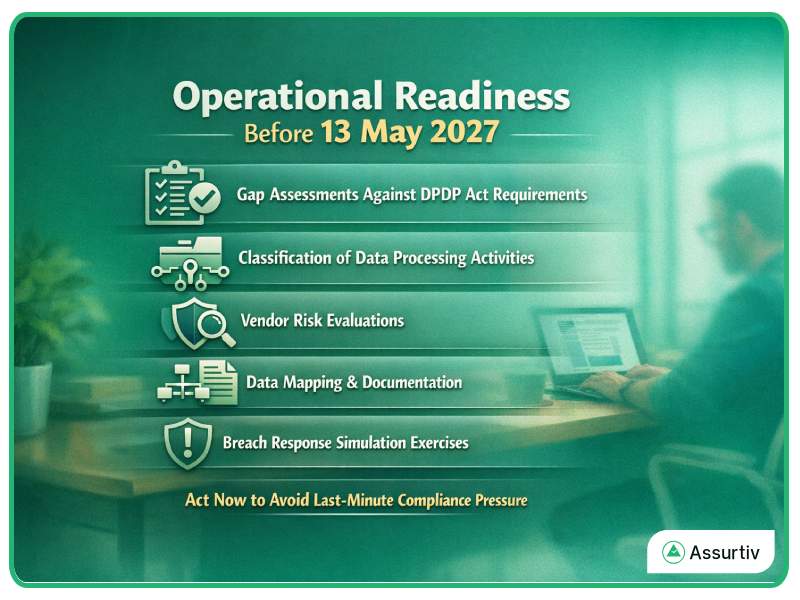
The enforcement date provides limited preparation time.
Organizations should prioritize:
- Gap assessments against DPDP Act requirements
- Classification of data processing activities
- Vendor risk evaluations
- Data mapping and documentation
- Breach response simulation exercises
Prompt action reduces last-minute compliance pressure.
Reputational and Market Impact Beyond Financial Penalties
Financial penalties are only part of the equation.
Non-compliance may lead to:
- Loss of customer trust
- Investor scrutiny
- Contract termination by enterprise clients
- Regulatory investigation publicity
- Increased insurance premiums
In many cases, reputational damage exceeds the monetary penalty.
How Organizations Can Mitigate DPDP Penalty Risk
A proactive strategy includes:
- Establishing a cross-functional data governance committee
- Conducting regular privacy impact assessments
- Implementing continuous security monitoring
- Training employees on data handling obligations
- Strengthening documentation and audit trails
Compliance must shift from policy-driven to execution-driven.
Comparing DPDP Penalties to Global Data Protection Regimes
Globally, data protection enforcement has intensified, with frameworks like GDPR imposing significant fines.
The DPDP Act positions India within the same enforcement league, emphasizing:
- Accountability
- Transparency
- Data principal rights
- Security-first architecture
This alignment increases international expectations for Indian enterprises operating globally.
Long-Term Compliance Strategy
Compliance cannot be episodic.
A sustainable approach requires:
- Periodic policy review
- Ongoing risk assessments
- Board-level reporting cadence
- Technology-enabled monitoring
- Alignment with cybersecurity frameworks
Organizations that treat DPDP compliance as a strategic capability rather than a regulatory burden will achieve long-term resilience.
Conclusion
The DPDP Act violation penalties framework represents a structural transformation in India’s regulatory landscape. With maximum penalties reaching ₹250 crore and enforcement effective from 13 May 2027, organizations face unprecedented financial and governance exposure.
Boards and executive leaders must act decisively strengthening cybersecurity, formalizing governance controls, and embedding compliance within enterprise risk strategy.
Data protection is no longer a legal department’s responsibility. It is a board-level priority, risk management imperative, and strategic difference in a digital-first economy.
Organizations that prepare early will not only avoid penalties—they will build trust, strengthen resilience, and enhance long-term competitive advantage.
Frequently Asked Questions (FAQs)
What is the maximum penalty under the DPDP Act?
The maximum penalty under the DPDP Act can reach ₹250 crore, particularly for failure to implement reasonable security safeguards or for Significant Data Fiduciary governance failures.
When will the DPDP Act penalties become applicable?
The penalty framework under the DPDP Act will become enforceable from 13 May 2027, giving organizations a limited window to strengthen compliance measures.
What is the penalty for failing to report a data breach under the DPDP Act?
Failure to notify authorities and affected individuals about a data breach may attract penalties of up to ₹200 crore, depending on the severity and circumstances.
What penalties apply to non-compliance involving children’s data?
Organizations that fail to comply with obligations related to children’s data—such as obtaining verifiable parental consent—may face penalties up to ₹150 crore.
Who is classified as a Significant Data Fiduciary (SDF) under the DPDP Act?
A Significant Data Fiduciary is an entity designated by the government based on factors like data volume, sensitivity, and risk exposure. SDFs must implement enhanced governance measures, and non-compliance can attract penalties up to ₹250 crore.