DPDP Rules 2025: Every Indian Business Must Need to Know
Dhiren M | 21 Nov 2025 | Not Modified
India’s data protection landscape is undergoing a fundamental shift. With the rollout of the DPDP Rules 2025 under the Digital Personal Data Protection Act (DPDPA) 2023, every Indian organization—across manufacturing, IT, BFSI, healthcare, retail, public sector, and emerging enterprise segments—must prepare for a structured, multi-phase implementation of the country’s most comprehensive data protection framework.
The DPDP Act is no longer a theoretical regulation. It is a nationwide compliance mandate designed to reshape how businesses manage personal data, mitigate risk, and build trust in a digitally expanding economy. The rollout, effective 14 November 2025, follows a three-phase activation model that organizations must understand and prepare for with precision.
Phase 1: Legal Foundation & Governance Activation
 Phase 1 lays down the foundational legal and governance infrastructure that will anchor long-term compliance efforts. Effectively it started from 14 November 2025. Here are Some points that need to focus on:
Activation of Core Definitions and Governance Scope
The first trigger is the operationalization of formal definitions under the DPDP Act 2023. These include the legal interpretation of personal data, data fiduciary, data principal, consent manager, and other governance-critical terminology. Once active, every organization must align internal interpretations and documentation with these statutory definitions.
Duties of Data Fiduciaries Come into Force
Organizations will now be legally accountable for fundamental responsibilities related to personal data handling. This includes transparent processing practices, responsible data lifecycle management, and adherence to statutory obligations that will expand in the later phases.
Establishment of the Data Protection Board
The Government of India gains the authority to constitute and operationalize the Data Protection Board. While enforcement intensifies in later phases, the formation of the Board establishes the regulatory authority that will adjudicate violations, define DPDP guidelines, and oversee compliance.
Penalty Framework Enabled
Though penalty issuance begins later, the legal structure for imposing financial penalties becomes active in Phase 1. Organizations must treat this as a strategic signal: early negligence will not be overlooked once full enforcement begins.
Industry Impact
Phase 1 is a readiness window; organizations must begin internal alignment, policy development, and baseline data protection literacy across functions. If you wait until Phase 3, then it will be significantly risky and operationally expensive.
Phase 2: Consent Ecosystem & Child-Data Safeguards Activation
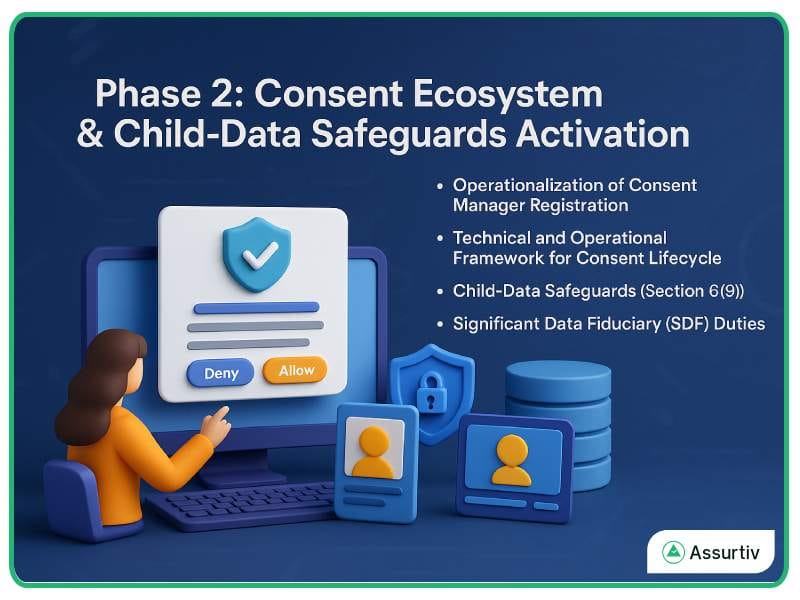 Phase 2 initiates the operational layers of the law—consent management, technical standards, and advanced safeguards that organizations must embed into their architecture.
Operationalization of Consent Manager Registration
Government-approved Consent Managers become formally recognized entities. Organizations must evaluate integration strategies with these systems and ensure their consent of lifecycle aligns with prescribed national standards.
Technical and Operational Framework for Consent Lifecycle
During Phase 2, the infrastructure surrounding consent—collection, storage, withdrawal, and logging comes into effect. This requires businesses to redesign or adapt systems handling user permissions, including applications, websites, portals, and backend systems.
Child-Data Safeguards (Section 6(9))
Stricter controls for children’s data are activated in this phase. Industries such as education technology, healthcare, gaming, content platforms, and retail loyalty solutions must implement elevated security controls, parental consent verification, and restricted data use protocols.
Significant Data Fiduciary (SDF) Duties
Organizations handling high-volume or high-impact personal data may be classified as SDFs. This triggers advanced compliance requirements, including governance controls, periodic audits, and detailed risk management obligations.
Industry Impact
Phase 2 requires organizations to begin technical alignment of consent workflows, system configurations, vendor ecosystem review, and preparation for SDF classification. It is a transformation phase that goes beyond policy documents into operational execution.
Phase 3: Full Compliance, Enforcement & Accountability
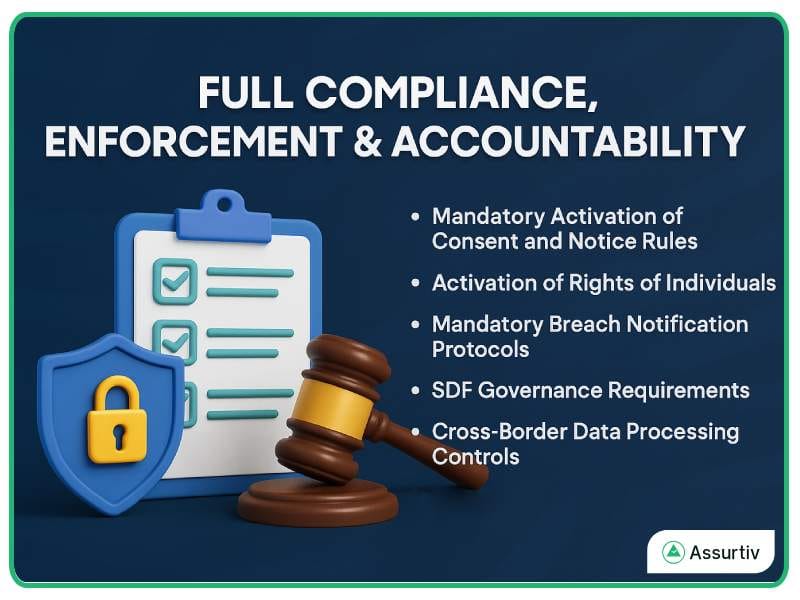 Phase 3 marks the point where the DPDP Rules 2025 move from preparation to enforcement. Every organization operating in India will be required to demonstrate compliance in real, auditable terms.
Mandatory Activation of Consent and Notice Rules
Organizations must ensure that every data processing activity is backed by explicit, verifiable consent and contextual notices. This includes digital platforms, offline data collection, workforce systems, partner ecosystems, and third-party processors.
Activation of Rights of Individuals
Individuals gain enforceable rights- access, correction, deletion, grievance, redressal, and consent of withdrawal. Organizations must create workflows, response mechanisms, and verification processes to handle these requests within legally prescribed timelines.
Mandatory Breach Notification Protocols
Organizations must adopt and maintain an effective breach of detection, assessment, and notification mechanism. Failure to notify the Board and affected data principles within a reasonable timeframe can trigger substantial penalties.
SDF Governance Requirements
Significant Data Fiduciaries must implement enterprise-grade governance:
- Appointment of a Data Protection Officer
- Mandatory independent audits
- Data Protection Impact Assessments (DPIA) for high-risk activities
- Strengthened monitoring and reporting practices
Cross-Border Data Processing Controls
DPDP introduces clear conditions for international data transfers. Organizations must review their data storage models, third-party processors, SaaS vendors, and inter-country operational flows.
Industry Impact
Phase 3 is the full compliance and enforcement stage—organizations must be operationally, technically, and legally prepared. This phase marks the beginning of accountability at scale.
Penalty Framework
The DPDP Act includes one of the strongest penalty structures in India’s regulatory history, that is going to Applicable from 13 May 2027. Maximum penalties can reach:
- ₹250 Cr for security safeguard failures
- ₹200 Cr for breach-notification violations
- ₹150 Cr for children’s data non-compliance
- ₹250 Cr for SDF governance failures
- ₹50 Cr for other violations
This penalty architecture reflects the seriousness with which the law expects organizations to handle personal data.
What Organizations Must Start Doing Now
Indian enterprises across all sectors, should activate a structured readiness program. Key priorities include:
- Revising privacy notices and user-facing disclosures
- Implementing lawful consent mechanisms
- Developing workflows for rights-based requests
- Strengthening cybersecurity and breach-response capabilities
- Conducting data discovery and mapping exercises
- Assessing SDF applicability and preparing governance structures
- Reviewing vendor compliance and data-sharing agreements
Organizations that act early will lower regulatory exposure, strengthen operational trust, and ensure smoother transition during the enforcement phase.
How Assurtiv Helps Organizations Align with DPDP Rules 2025
 To stay compliant with the new rules of the DPDP Act, organizations need continuous governance—not a one-time effort.
This is where Assurtiv, our AI-powered GRC platform, becomes a game-changer.
Automated DPDP Readiness Assessments
Assurtiv instantly analyzes your organization’s current posture against DPDP Rules 2025 guidelines and highlights gaps in:
- Consent workflows
- Data lifecycle
- User rights processes
- Vendor compliance
- Security posture
- Governance documentation
You get a clear, actionable roadmap to compliance—without manual guesswork.
AI-Assisted Policy & Notice Generation
Assurtiv helps organizations rapidly generate:
- DPDP-compliant privacy notices
- Data processing policies
- Consent management SOPs
- Breach notification templates
- Data classification frameworks
This cuts compliance timelines drastically for busy business leaders.
Continuous Monitoring & Evidence Collection
Our platform automates:
- Control monitoring
- Evidence gathering
- Audit trail creation
- Risk scoring & reporting
This ensures ongoing compliance—not just point-in-time readiness.
Assurtiv Also Helps You Become ISO Ready
Along with DPDP compliance, Assurtiv supports organizations aiming to become ISO-ready, especially:
- ISO 27001 (Information Security Management)
- ISO 9001 (Quality Management Systems)
With Assurtiv, you get:
- Pre-built ISO control libraries
- Automated AI evidence mapping
- Policy templates
- Risk treatment plans
- Internal audit guidance
- Consultant support with minimal manual effort
Whether you’re preparing enterprise deals, investor due diligence, or global expansion, Assurtiv ensures your organization is strong, audit ready, and compliance aligned.
DPDP Compliance Isn’t Optional, It’s a Mandate
The DPDP Rules 2025 are more than a legal requirement—they represent a strategic shift in India’s digital economy. Every business that collects or processes personal data must now align itself with a structured compliance roadmap that spans governance, technology, security, and user rights.
The countdown has begun. The question for Indian organizations today is not “Do we need to comply?”
but “How fast can we adapt, strengthen systems, and ensure responsible data stewardship?”
With Assurtiv, compliance becomes faster, smarter, and deeply integrated—empowering organizations to move confidently into the new regulatory era.