ESG Compliance & GRC Integration: A Practical Framework for 2026
Rudramuni Swamy H M | 19 Dec 2025 | Not Modified
Environmental, Social, and Governance (ESG) compliance has rapidly moved from a “nice-to-have” sustainability initiative to a core business requirement. Regulators, investors, customers, and employees now expect organizations to prove how they manage ESG risks, controls, and reporting — not just talk about them.
As ESG requirements grow more complex, one thing is becoming clear: ESG cannot be managed in isolation. It must be integrated into an organization’s Governance, Risk, and Compliance (GRC) framework to be effective, scalable, and defensible.
In this post, I will explain what ESG compliance really means, why it belongs within GRC, and how organizations can build a practical ESG–GRC integration framework for 2026 and beyond.
What Is ESG Compliance?
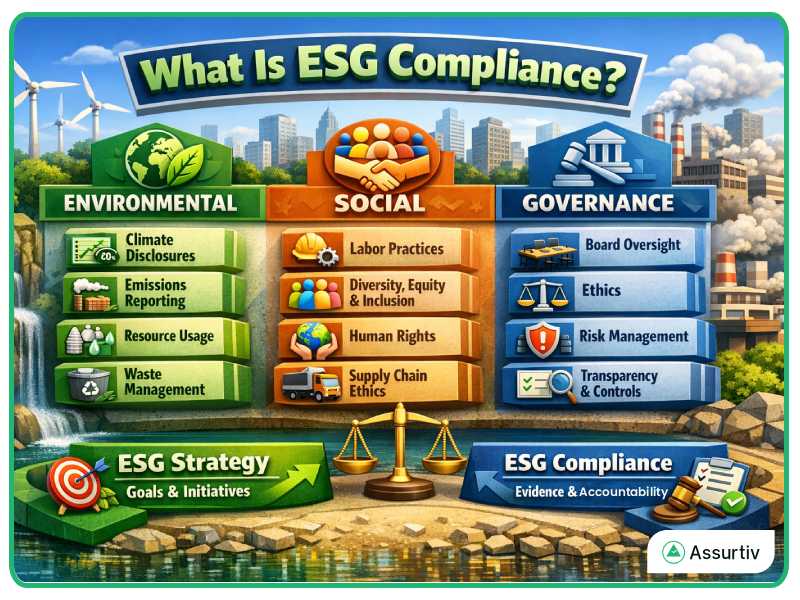
ESG compliance refers to an organization’s ability to meet regulatory, reporting, and internal governance requirements related to environmental, social, and governance factors.
Unlike traditional compliance (which often focuses on a single regulation), ESG compliance spans multiple dimensions:
- Environmental: Climate Disclosures, Emissions reporting, Resource usage, Waste management
- Social: Labor practices, Diversity, Equity, and Inclusion (DE&I) Metrics, Human rights, supply-chain ethics
- Governance: Board oversight, Ethics, Risk management, Transparency, Internal controls
Importantly, ESG compliance is not the same as the ESG strategy.
- ESG strategy focuses on goals, commitments, and initiatives
- ESG compliance focuses on evidence, controls, accountability, and regulatory adherence
This distinction is why ESG increasingly falls under compliance, risk, and governance teams, not just sustainability departments.
Why ESG Is Now a GRC Priority
ESG has become a GRC priority for three key reasons:
Regulatory Pressure Is Increasing
Governments and regulators worldwide are introducing mandatory ESG disclosures, assurance requirements, and enforcement mechanisms. Organizations are now legally accountable for the accuracy and completeness of ESG data.
ESG Failures are Risk Events
Greenwashing claims, Supply-chain labor violations, or Inaccurate climate disclosures can result in:
- Regulatory penalties
- Investor lawsuits
- Brand damage
- Loss of market trust
These are Enterprise Risks, not just sustainability issues.
ESG Requires Governance, Controls, and Monitoring
Effective ESG programs require:
- Clear ownership and accountability
- Internal controls
- Continuous monitoring
These are core GRC capabilities, making integration essential.
Key ESG Regulations and Reporting Frameworks (2025–2026)
Organizations must navigate an increasingly complex ESG regulatory landscape. Some of the most influential frameworks and regulations include:
Major ESG Regulations
- CSRD (Corporate Sustainability Reporting Directive – EU)
Expands mandatory ESG reporting and assurance requirements
- SEC Climate Disclosure Rules (US)
Climate-related risk and emissions disclosures for public companies
- UK Sustainability Disclosure Requirements (SDR)
Focused on transparency and anti-greenwashing measures
Global ESG Reporting Frameworks
- GRI (Global Reporting Initiative)
- SASB (Sustainability Accounting Standards Board)
- TCFD (Task Force on Climate-related Financial Disclosures)
- ISSB (International Sustainability Standards Board)
Managing compliance across these frameworks without a centralized GRC approach quickly becomes inefficient and risky.
Why ESG Cannot Exist Without GRC
At its core, ESG compliance is a Governance, Risk, and Compliance challenge.
Here’s how ESG naturally aligns with GRC:
| ESG Component | GRC Capability |
| ESG Governance | Policies, Board oversight, Accountability |
| ESG Risk | Risk identification, Risk Assessments, KRIs |
| ESG Controls | Internal controls, Audits, Testing |
| ESG Reporting | Evidence Management, Workflows, Monitoring |
When ESG operates outside GRC:
- Data lives in silos
- Accountability is unclear
- Controls are inconsistent
- Audits become painful and reactive
When ESG is integrated into GRC, organizations gain consistency, traceability, and confidence.
ESG Risks Organizations Must Manage
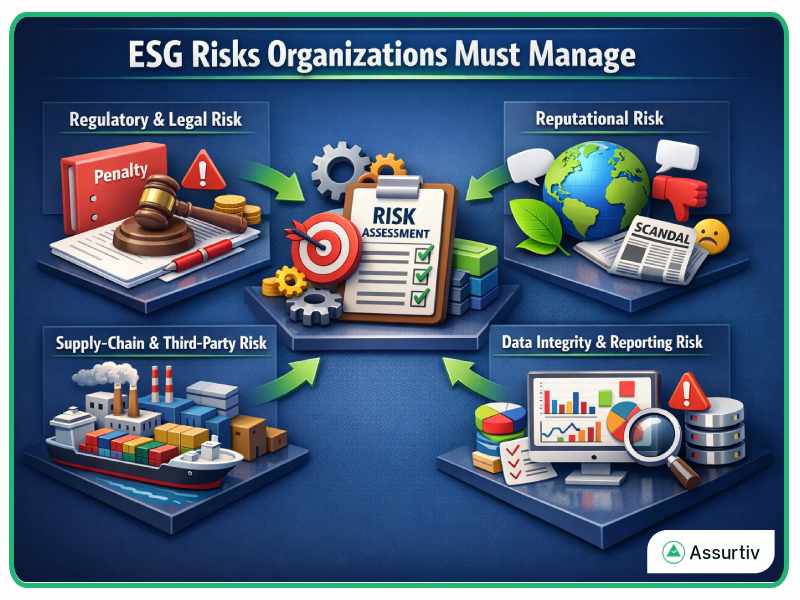
Effective ESG compliance starts with understanding ESG-related risks. Common categories include:
Regulatory and Legal Risk
Failure to meet ESG disclosure or reporting requirements can result in fines, sanctions, and legal exposure.
Reputational Risk
Inaccurate claims, greenwashing, or social misconduct can rapidly erode stakeholder trust.
Supply-Chain and Third-Party Risk
Many ESG failures occur outside the organization — within vendors, suppliers, or partners.
Data Integrity and Reporting Risk
ESG data often comes from multiple sources and systems, increasing the risk of errors or inconsistencies.
These risks must be identified, assessed, tracked, and monitored just like any other enterprise risk — using GRC methodologies.
How to Integrate ESG into an Existing GRC Framework (Step-by-Step)
A practical ESG–GRC integration does not require reinventing your GRC program. Instead, it builds on what already exists.
Step 1: Map ESG Requirements to Existing Governance Structures
Identify which ESG regulations and frameworks apply to your organization and map them to:
- Policies
- Committees
- Owners
- Reporting obligations
Step 2: Identify ESG Risks and Controls
Incorporate ESG risks into your enterprise risk register, including:
- Environmental risks
- Social and human rights risks
- Governance and ethics risks
Define controls to mitigate those risks.
Step 3: Assign Clear Ownership and Accountability
Every ESG risk, control, and metric should have:
- A clear owner
- Defined responsibilities
- Escalation paths
Step 4: Centralize Evidence and Documentation
Use GRC workflows to collect, store, and manage:
- ESG data
- Supporting evidence
- Audit trails
This dramatically reduces audit and reporting friction.
Step 5: Monitor, Report, and Improve Continuously
ESG compliance is ongoing. Integrate ESG metrics into:
- Dashboards
- Continuous monitoring
- Internal audits
- Management reviews
The Role of Technology and Automation in ESG Compliance
Manual ESG processes do not scale. Technology plays a critical role in enabling integrated ESG–GRC programs by providing:
- Centralized ESG data management
- Automated control testing
- Real-time risk visibility
- Workflow-driven reporting
- Always audit readiness
Modern GRC platforms allow organizations to treat ESG as a living compliance program, not a once-a-year reporting exercise.
ESG and GRC Best Practices for 2026
Organizations leading in ESG compliance follow these best practices:
- Treat ESG as an enterprise risk discipline, not a siloed initiative
- Integrate ESG into existing GRC frameworks instead of building parallel systems
- Align ESG KPIs with business objectives and risk appetite
- Continuously assess third-party ESG risks
- Prepare for ESG assurance and audits early, not reactively
These practices improve resilience, transparency, and stakeholder trust.
The Future of ESG and GRC Integration
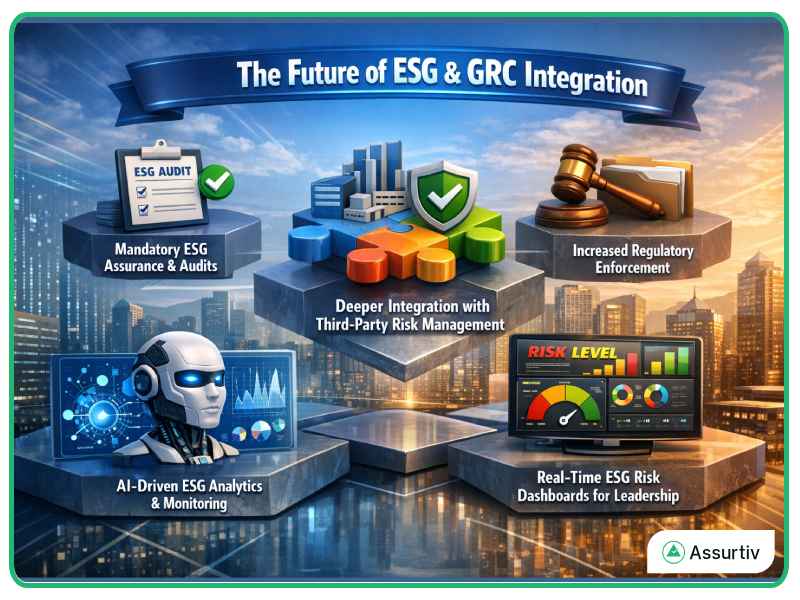
Looking ahead, ESG and GRC will become even more intertwined. Key trends include:
- Mandatory ESG assurance and audits
- Increased regulatory enforcement
- Deeper integration with third-party risk management
- AI-driven ESG analytics and monitoring
- Real-time ESG risk dashboards for leadership
Organizations that integrate ESG into GRC today will be better prepared for future regulations, scrutiny, and expectations.
Conclusion:
ESG compliance is no longer just about sustainability reporting — it is about governance, accountability, and risk management. Without a strong GRC foundation, ESG programs struggle to scale, prove compliance, or withstand scrutiny.
By integrating ESG into an existing GRC framework, organizations can:
- Reduce compliance risk
- Improve data accuracy
- Increase transparency
- Build long-term trust with stakeholders
As ESG requirements continue to evolve, integrated GRC-driven ESG compliance will become the standard, not the exception.