ESG Risk Assessment: A Step-by-Step Guide for Compliance Teams
Rudramuni Swamy H M | 26 Dec 2025 | 28 Dec 2025
Environmental, Social, and Governance (ESG) risks are no longer abstract sustainability concerns—they are enterprise-level risks with direct regulatory, financial, and reputational consequences. As ESG regulations expand and stakeholder scrutiny increases, organizations must move beyond high-level ESG commitments and adopt structured, defensible ESG risk assessment practices.
For compliance teams, ESG risk assessment has become a critical part of ESG risk management, enabling organizations to identify exposure, prioritize controls, and demonstrate accountability. This guide explains how to conduct an ESG risk assessment using a practical, step-by-step framework aligned with modern GRC practices.
Why ESG Risk Assessment Matters
ESG risks affect business continuity, regulatory compliance, investor confidence, and brand reputation. Climate disclosures, labor practices, supply-chain ethics, and governance failures can all trigger enforcement actions and long-term damage.
Importantly, ESG risks are enterprise risks, not isolated sustainability issues. That is why ESG risk assessment must be integrated into broader governance, risk, and compliance programs rather than managed in silos.
A structured ESG risk assessment supports the broader ESG Compliance & GRC Integration approach by providing clarity on where risks exist, how severe they are, and what actions are required to manage them effectively.
What Is an ESG Risk Assessment?
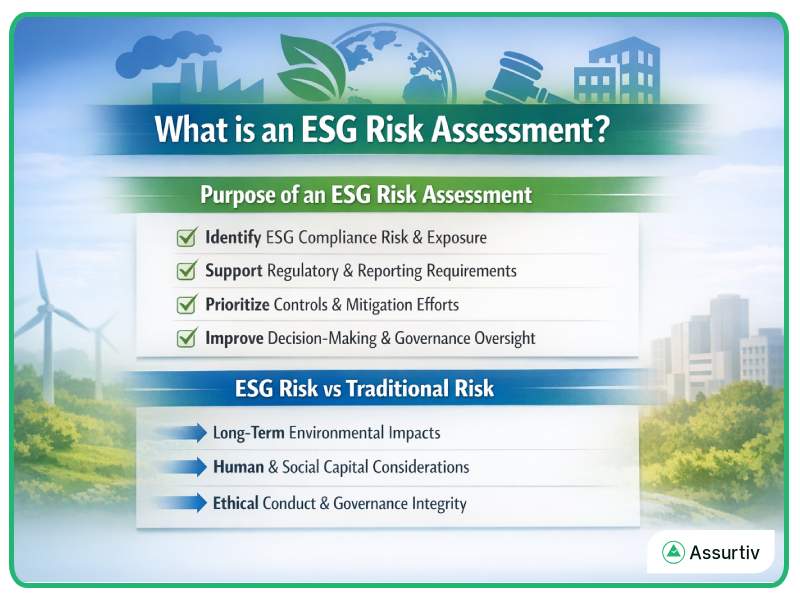
An ESG risk assessment is a systematic process used to identify, evaluate, and prioritize risks related to environmental, social, and governance factors that may impact an organization’s objectives, compliance obligations, or stakeholders.
Purpose of an ESG Risk Assessment
- Identify ESG compliance risk and exposure
- Support regulatory and reporting requirements
- Prioritize controls and mitigation efforts
- Improve decision-making and governance oversight
ESG Risk vs Traditional Risk
While traditional risk assessments often focus on financial, operational, or cybersecurity risks, ESG risk assessments expand the lens to include:
- Long-term environmental impacts
- Human and social capital considerations
- Ethical conduct and governance integrity
ESG risks are often interconnected, forward-looking, and influenced by external stakeholders, making structured assessment essential.
Key Categories of ESG Risk
A comprehensive ESG risk identification process typically covers three core categories:
Environmental Risks
Environmental risks relate to how an organization impacts—and is impacted by—the natural environment.
Examples include:
- Climate change and transition risks
- Greenhouse gas emissions
- Energy and resource usage
- Waste management and pollution
Failure to manage environmental risks can result in regulatory penalties, operational disruptions, and reputational damage.
Social Risks
Social risks focus on people, relationships, and societal expectations.
Examples include:
- Labor practices and workplace safety
- Diversity, equity, and inclusion (DEI)
- Human rights violations
- Supply-chain labor conditions
These risks are often amplified through third-party relationships and global operations.
Governance Risks
Governance risks relate to leadership, oversight, and ethical conduct.
Examples include:
- Weak board oversight
- Conflicts of interest
- Inadequate policies and controls
- Lack of transparency and accountability
Governance failures frequently undermine environmental and social commitments, making this category especially critical.
ESG Risk Assessment Framework (Step-by-Step)
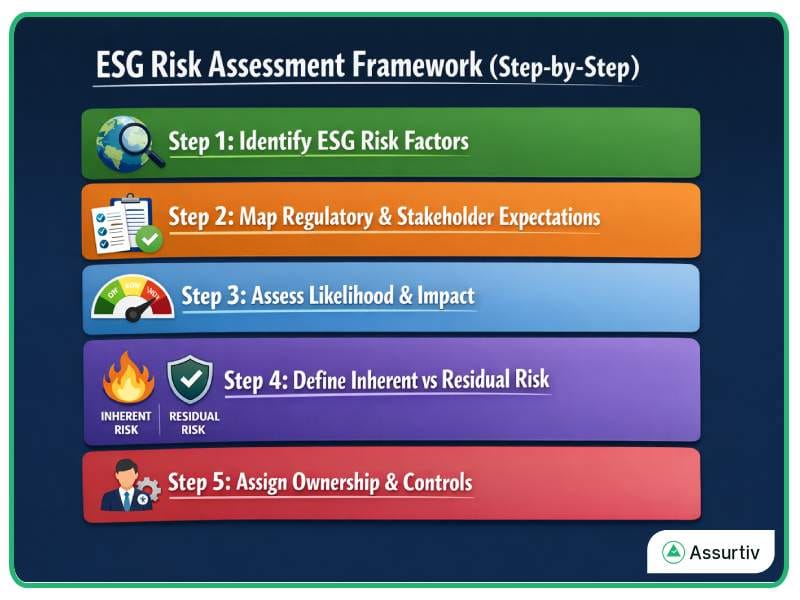
An effective ESG risk assessment framework follows a structured and repeatable process.
Step 1: Identify ESG Risk Factors
Begin by identifying ESG risks relevant to your organization’s industry, geography, operations, and value chain. Use:
- Regulatory requirements
- Industry standards
- Internal policies
- Past incidents
Step 2: Map Regulatory and Stakeholder Expectations
Identify applicable ESG regulations, reporting frameworks, and stakeholder expectations, such as:
- CSRD, SEC climate rules
- GRI, TCFD, ISSB standards
- Investor and customer expectations
This ensures ESG compliance risk is accurately captured.
Step 3: Assess Likelihood and Impact
Evaluate each ESG risk based on:
- Likelihood of occurrence
- Potential impact (financial, regulatory, reputational, operational)
This step forms the foundation of ESG risk scoring.
Step 4: Define Inherent vs Residual Risk
- Inherent risk: Risk level before controls
- Residual risk: Risk level after controls
Understanding the gap helps determine whether existing controls are sufficient.
Step 5: Assign Ownership and Controls
Each ESG risk should have:
- A clearly defined owner
- Documented controls and mitigation actions
- Escalation and reporting mechanisms
Accountability is essential for effective ESG risk management.
ESG Risk Scoring & Metrics
Risk scoring helps prioritize ESG risks and allocate resources effectively.
Qualitative vs Quantitative Scoring
- Qualitative scoring: Uses descriptive ratings (low, medium, high)
- Quantitative scoring: Uses numerical values and thresholds
Many organizations use a hybrid approach.
Key Risk Indicators (KRIs) for ESG
Examples include:
- Emissions intensity trends
- Employee turnover and safety incidents
- Supplier compliance violations
- Policy breaches or ethics reports
KRIs enable ongoing monitoring beyond periodic assessments.
Integrating ESG Risk Into GRC
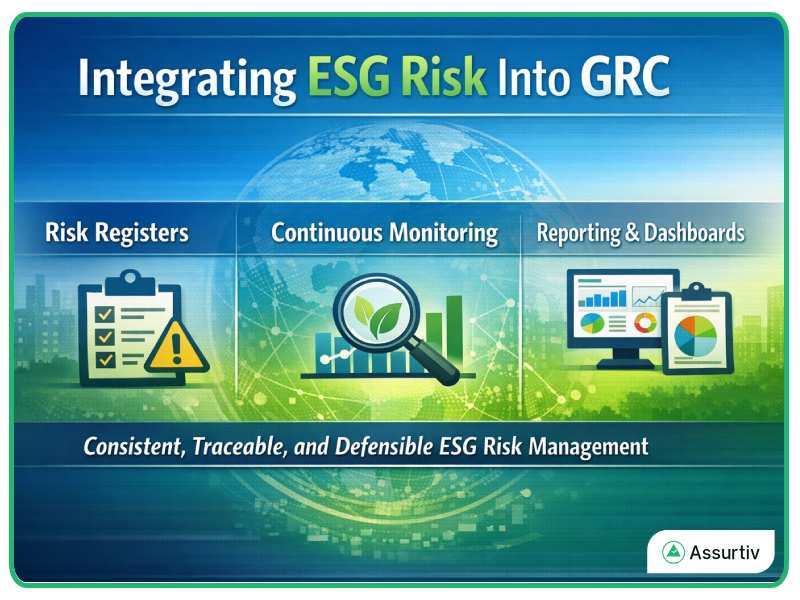
To be effective, ESG risk assessments must be embedded into existing GRC processes.
Risk Registers
ESG risks should be included in enterprise risk registers alongside other strategic and operational risks.
Continuous Monitoring
Ongoing monitoring helps detect emerging ESG risks and track changes in exposure.
Reporting and Dashboards
Clear reporting supports:
- Management oversight
- Board-level decision-making
- Regulatory and audit readiness
Integration ensures that ESG risk management is consistent, traceable, and defensible.
ESG Risk Assessment Best Practices
Organizations with mature ESG programs follow these best practices:
- Conduct regular ESG risk reassessments
- Include third-party and supply-chain risks
- Align ESG risks with enterprise risk management
- Use automation to improve accuracy and scalability
- Document decisions and assumptions
Treating ESG risk assessment as a one-time exercise limits its value.
ESG Risk Assessment as a Living Process
An effective ESG risk assessment is not a static document—it is a living process that evolves with regulations, business strategy, and stakeholder expectations.
By implementing a structured ESG risk assessment framework, compliance teams can:
- Proactively manage ESG compliance risk
- Strengthen governance and accountability
- Improve transparency and audit readiness
As ESG requirements continue to expand, organizations that integrate ESG risk management into their GRC programs will be better positioned to respond with confidence.
Looking to strengthen ESG risk assessment within your GRC framework?
Modern GRC platforms can help centralize ESG risks, automate assessments, and support continuous monitoring—enabling compliance teams to move from reactive reporting to proactive ESG governance.