How to Automate Evidence Collection and Tracking
Dhiren M | 14 Nov 2025 | Not Modified
In today’s highly regulated business landscape, proving compliance isn’t optional, it’s a necessity. Every audit, certification, and risk assessment demands accurate, up-to-date evidence. But for many organizations, collecting and tracking evidence remains a time-consuming, error-prone process.
If your compliance team still relies on spreadsheets, shared drives, and endless email chains, it’s time for a smarter approach. This is where automate evidence collection and tracking becomes a game changer, empowering leadership and compliance teams alike to save time, reduce risk, and achieve continuous compliance.
Whether you’re a CEO or MD focused on operational efficiency, a CISO or CPO responsible for security and privacy, or a manager ensuring audit readiness, understanding how automated evidence collection can transform your governance strategy.
Manual Evidence Collection Is Broken
Traditional evidence collection methods were never designed for modern enterprises. Compliance requirements have expanded rapidly- covering frameworks like ISO 27001, SOC 2, GDPR, HIPAA, and PCI DSS, all demanding hundreds of controls and proof points.
Common challenges include:
- Scattered data: Evidence lives in multiple tools, systems, and departments.
- Inconsistent updates: Teams forget to refresh old data or repeat outdated processes.
- Audit fatigue: Collecting the same evidence for multiple audits leads to duplication of effort.
- Lack of visibility: Leaders can’t see real-time compliance progress or risks.
The result?
Compliance becomes reactive, stressful, and costly, consuming valuable time that could be spent on strategic initiatives.
Automation addresses these pain points head-on, giving organizations a scalable and efficient way to collect, track, and validate evidence in real time.
Why Automate Evidence Collection and Tracking?
Automation doesn’t just make compliance faster- makes it smarter and more resilient.
Here’s why forward-thinking leaders are embracing it:
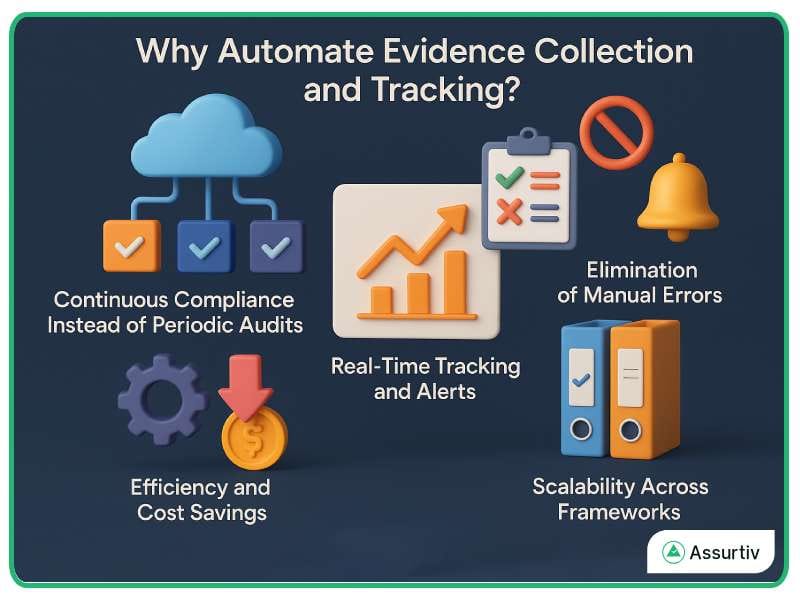
Continuous Compliance Instead of Periodic Audits
Automated systems continuously collect evidence from your business tools- cloud services, HR systems, identity platforms, and endpoint security tools. This means compliance isn’t a one-time task before an audit; it’s a living, ongoing process.
Elimination of Manual Errors
By automating data collection, organizations eliminate the inconsistencies and human errors that can jeopardize audit outcomes or trigger regulatory penalties.
Real-Time Tracking and Alerts
Automated tracking dashboards provide visibility into control performance, evidence of submission, and risk posture. CISOs and compliance leads can instantly see where compliance gaps exist and act before they escalate.
Efficiency and Cost Savings
Automation can reduce compliance effort by up to 60%. That is fewer manual checks, fewer repetitive uploads, and faster audits, translating to significant operational savings.
Scalability Across Frameworks
Once your evidence collection process is automated, you can map the same controls across multiple frameworks like SOC 2 and ISO 27001, without duplicating effort.
For decision makers like CEOs and MDs, this means better governance with lower costs.
For compliance teams and managers, it means more time for analysis and proactive risk mitigation instead of busy administrative busy work.
How to Automate Evidence Collection and Tracking
 Step 1: Identify Your Compliance Frameworks
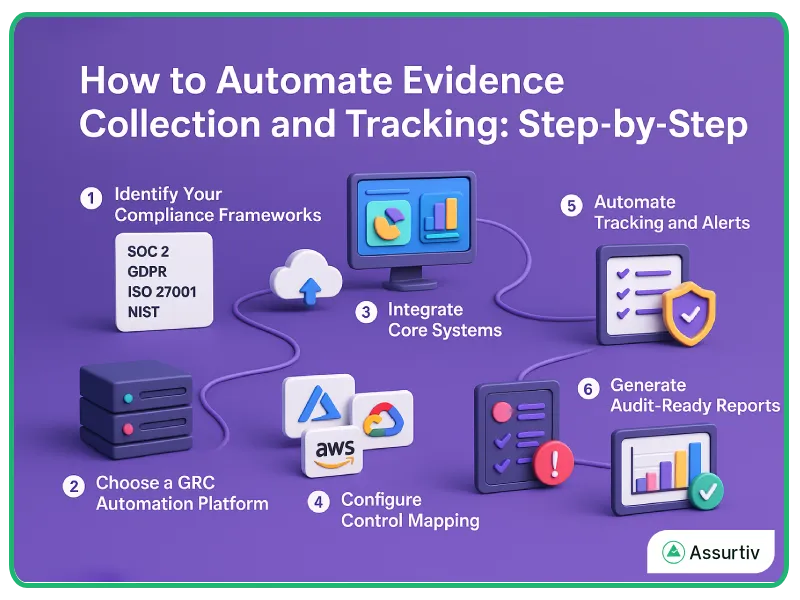
Start by defining which regulations or standards apply to your organization, such as SOC 2, GDPR, ISO 27001, or NIST. Each framework has unique evidence requirements. Mapping them early helps determine what data needs to be collected and from where.
Step 2: Choose a GRC Automation Platform
The foundation of automation lies in the right technology. Modern GRC (Governance, Risk, and Compliance) platforms– like Assurtiv, are built to integrate with your existing systems, automatically fetching and validating evidence across your IT and business landscape.
A robust GRC platform can:
- Pull logs and configurations from connected tools
- Auto-tag and organize evidence by framework
- Track evidence history for audits
- Provide real-time dashboards and compliance scoring
Step 3: Integrate Core Systems
To enable automation, connect your key data sources, cloud platforms (AWS, Azure, Google Cloud), HR systems, IT asset tools, identity management systems, and security monitoring tools. This integration ensures continuous evidence of flow from authentic sources without human intervention.
Step 4: Configure Control Mapping
Each compliance control like password policies, access reviews, or data encryption should be linked to its respective data point. This ensures that the right evidence is automatically collected and mapped to the correct framework requirement.
Step 5: Automate Tracking and Alerts
Once evidence flows automatically, set up tracking mechanisms that:
- Flag missing or expired evidence
- Notify control owners when updates are due
- Alert managers about compliance gaps
This proactive tracking ensures no evidence is forgotten or outdated before an audit.
Step 6: Generate Audit-Ready Reports
Automated systems can generate detailed compliance reports and dashboards for internal teams and auditors.
Instead of scrambling weeks before an audit, your reports are always current, complete, and verified.
The Role of Assurtiv GRC Tool
GRC automation tools like Assurtiv are redefining compliance management. The tools makes it simple for enterprises to automate evidence collection and maintain traceability from policy to proof.
With Assurtiv, you can:
- Automatically collects evidence from multiple data sources.
- Track evidence status, ownership, and audit trails in real-time.
- Map evidence across multiple compliance frameworks simultaneously.
- Enable AI-powered insights to predict potential compliance gaps.
- Simplify auditor collaboration with centralized dashboards.
This unified automation approach transforms compliance from a bottleneck into a business enabler, helping organizations scale governance efficiently without adding CAPEX or manual workload.
What Different Decision Makers Gain
For Managing Directors and CEOs
Automated evidence collection means reduced compliance costs, faster audits, and greater organizational transparency. It helps maintain investor and customer trust while ensuring smooth regulatory operations.
For CISOs
You gain continuous visibility into security controls, ensuring your defense posture remains compliant with cybersecurity frameworks like NIST or ISO 27001—without chasing teams for logs or screenshots.
For CPOs
Automation ensures data privacy controls are validated in real time, reducing the risk of non-compliance with GDPR or CCPA. It also enhances confidence in how customer data is managed and protected.
For Compliance Managers and Team Leads
Your day-to-day becomes easier. Instead of manual follow-ups and document checks, you can focus on higher-value tasks like risk analysis and compliance optimization.
Future of Compliance Lies in Automation
Imagine your compliance dashboard flagging an access control issue automatically or suggesting corrective actions ahead of an audit. That is the direction automation is heading, and early adopters will lead in governance maturity.
Conclusion
Manual compliance is costly, error-prone, and outdated. When you automate evidence collection and tracking, you create a system that’s proactive, transparent, and audit-ready every day.
Whether you are leading a company, securing data, or managing audits, automation empowers your teams to focus on growth not paperwork.
Start your automation journey with Assurtiv today—because compliance should drive progress, not slow it down.