ISO 27001 for Startups: The Brutal Truth Founders Must Hear Before It’s Too Late
Dhiren M | 28 Nov 2025 | Not Modified
Startups dream fast, build fast, and break things fast.
Unfortunately, in 2025 — cybercriminals move even faster.
Founders often treat ISO 27001 like a trophy to win enterprise deals.
Some chase the certification like a badge of honour. Others see it as a shortcut to investor trust.
But here’s the uncomfortable truth (and every founder deserves to hear it):
ISO 27001 won’t secure your startup unless YOU are willing to secure it.
The certificate is not protection — your culture, decisions, and discipline are.
This isn’t philosophy. It’s based on hard, painful lessons from companies that proudly framed their ISO certificate on the office wall — and still got breached, bankrupted, or reputationally burned.
Startups got hacked not because ISO failed… but because their implementation failed.
Let’s explore the harsh truths — and why ISO 27001 for startups is not optional anymore… but must be done the right way.
ISO 27001 Isn’t Just a Compliance Strategy — It’s a Leadership Decision
For many startups, ISO 27001 becomes a checkbox to unlock enterprise deals. They look at it as a certification exercise rather than a leadership commitment. But the truth is far more uncomfortable: ISO 27001 exposes your weaknesses; it does not hide them.
Startups often underestimate the cultural shift required to embrace ISO. Security becomes meaningful only when leadership treats it as a business priority rather than an audit requirement.
ISO demands structure, discipline, repeatability, and awareness. These qualities cannot be bolted on during audit season; they must be built into the DNA of the company.
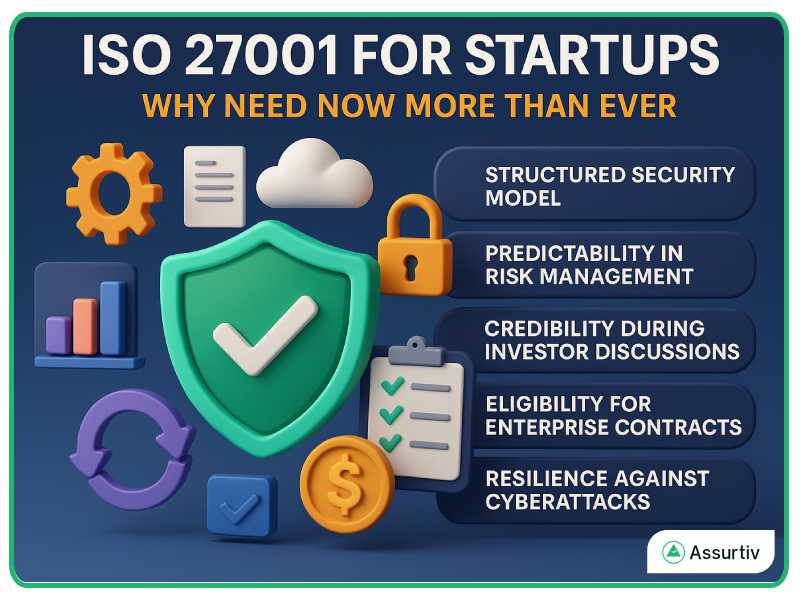
ISO 27001 for Startups Why Need Now More Than Ever
The digital journey of a startup is radically different from that of an enterprise. Startups scale fast, adopt tools faster, and ship features at lightning speed. In this environment, misconfigurations, access oversights, risky dependencies, and weak operational controls become part of daily life.
This is precisely why ISO 27001 for startups is becoming indispensable. It brings:
- A structured security model for chaotic environments
- Predictability in risk management
- Credibility during investor discussions
- Eligibility for enterprise contracts
- Resilience against cyberattacks
But most importantly, ISO 27001 gives startups a repeatable operational backbone — something fast-growing teams desperately need.
Where Startups Go Wrong (And Why ISO Fails Them)
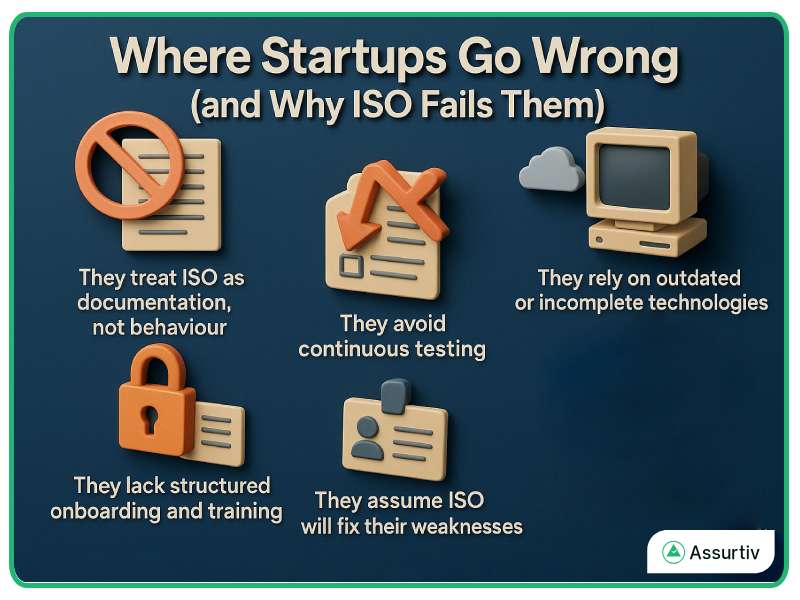 Startups struggle not because ISO is complex, but because:
They treat ISO as documentation, not behaviour.
Policies become static files no one reads. Processes become checklists no one follows.
They rely on outdated or incomplete technologies.
Logging, monitoring, EDR tools, and access discipline get ignored in the rush to build.
They avoid continuous testing.
Incident plans, backup rehearsals, and vulnerability scans happen “when time permits” — which often means never.
They lack structured onboarding and training.
New employees don’t learn security. Early employees retain too much access. Teams move fast but without guardrails.
They assume ISO will fix their weaknesses.
But ISO only highlights gaps. It does not fix behaviours, attitudes, or operational chaos.
A Realistic Example That Reflects Today’s Startup Challenges
Consider a fast-growing SaaS startup preparing for enterprise onboarding. They implement ISO 27001 under deadline pressure. Policies are drafted, risk registers created, evidence folders built, and the audit passed. On paper, they are secure.
But in reality?
- MFA isn’t consistently enforced
- Cloud logs are never reviewed
- Access lists contain ex-employees
- Developers deploy directly to production
- Incident response roles are undefined
One accidental misstep by a team member exposes a critical environment variable — and the company suffers a breach that ISO 27001 “didn’t prevent.”
Why? Because ISO 27001 never claims to prevent breaches.
It gives startups, the structure to prevent them — but only if that structure becomes routine.
The Mindset Shift: ISO as Culture, Not Certification
The startups that truly benefit from ISO 27001 treat it not as a project but as a discipline:
- Security reviews become part of sprint cycles
- Change management becomes consistent
- Access rights are audited monthly
- Incidents are simulated quarterly
- Developers embrace secure coding
- Leadership approves budgets for protection, not patches
This is the transformation ISO makes possible when adopted honestly.
How Assurtiv Helps Startups Implement ISO 27001 the Right Way
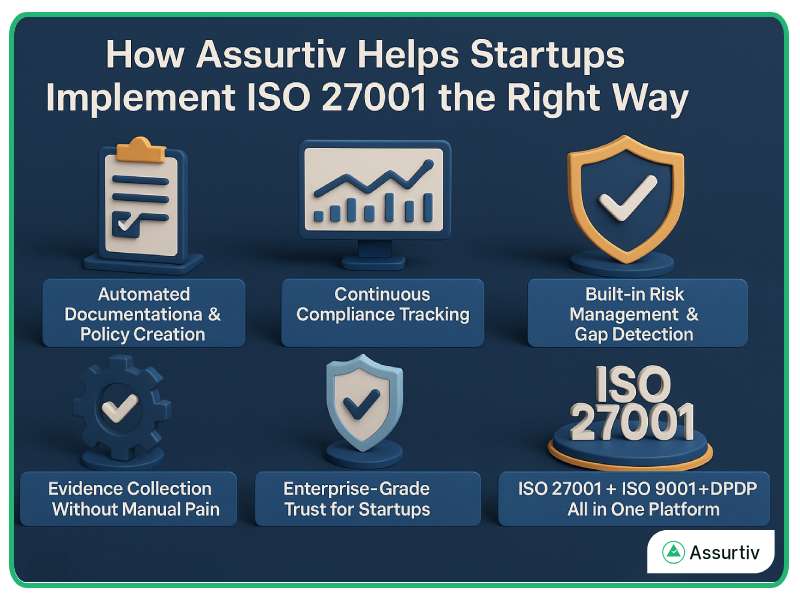 Most startups fail ISO not because they’re careless, but because they’re overloaded. Security leaders wear multiple hats. Founders juggle priorities. Tech teams move fast. Traditional ISO approaches slow them down — which is why they skip key steps.
Assurtiv, AI-powered GRC platform, solves this exact problem.
Assurtiv turns ISO 27001 into a daily, automated, intelligent process:
Automated Documentation & Policy Creation
Assurtiv generates ISO-ready policies, controls, and evidence — saving founders months of work.
Continuous Compliance Tracking
Real-time reminders, nudges, and dashboards ensure ISO maturity stays active, not seasonal.
Built-in Risk Management & Gap Detection
No spreadsheets. No missed tasks. Assurtiv identifies risks before auditors or customers do.
Evidence Collection Without Manual Pain
The platform maps evidence, tracks completion, and keeps you audit-ready every day.
Enterprise-Grade Trust for Startups
Assurtiv-GRC ensures a startup can demonstrate maturity equal to mid-sized enterprises — unlocking deals faster.
ISO 27001 + ISO 9001 + DPDP + SOC 2 — All in One Platform
Startups grow fast, and Assurtiv grows with them.
When founders use Assurtiv-GRC, ISO becomes a strategic advantage, not an administrative burden.
Conclusion
ISO 27001 for Startups Is Not a Certificate — It’s a Transformation. The certificate on the wall means nothing if the behaviours behind it don’t change. But when startups embrace ISO 27001 as a cultural shift — supported by intelligent tools like Assu — they gain not just compliance, but resilience, credibility, and long-term trust.
For founders ready to scale, ready to win enterprise business, and ready to build secure digital futures…
ISO 27001 is your foundation.
Assurtiv is your accelerator.