Modern GRC Strategy: Beyond Checkbox Compliance in 2026
Chakrapani KVC | 20 Feb 2026 | Not Modified
Regulatory pressure is intensifying. Cyber threats are accelerating. Stakeholder expectations are rising.
Yet many organizations still approach governance, risk, and compliance as a checklist of exercise, focused on passing audits rather than strengthening resilience.
The result?
Compliance fatigue. Fragmented reporting. Reactive risk management.
A modern GRC strategy changes this equation.
It shifts governance from obligation to advantage — transforming compliance into a strategic capability that protects value, enables growth, and strengthens decision-making.
What Is a Modern GRC Strategy?
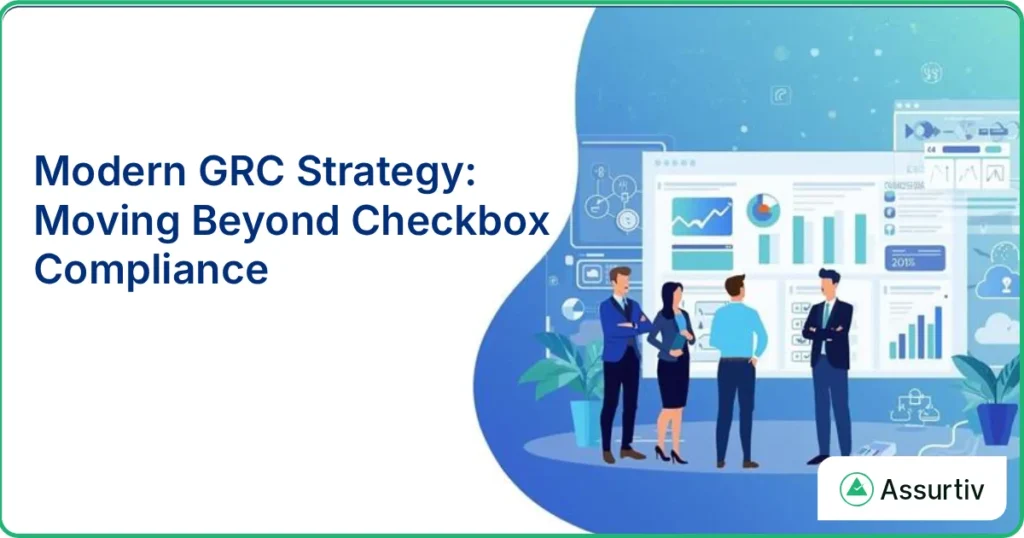
A modern GRC strategy is an integrated governance, risk, and compliance framework that aligns risk oversight, regulatory adherence, and control management with enterprise objectives — using automation, real-time data, and outcome-based metrics.
Unlike traditional models that focus on passing audits, a modern strategy emphasizes:
- Risk intelligence over risk documentation
- Continuous compliance over periodic assessments
- Strategic alignment over siloed reporting
- Business impact over control activity
At its core, it is a strategic GRC framework built on integration, visibility, and measurable outcomes.
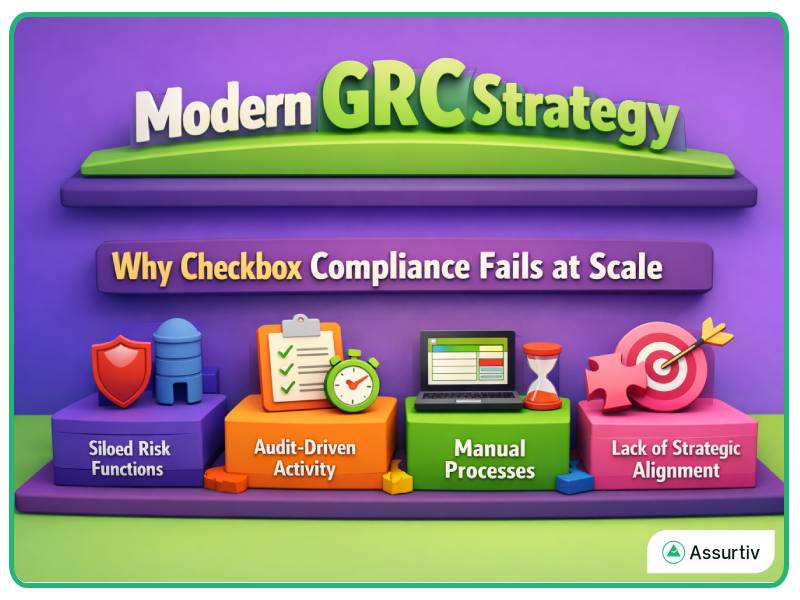
Why Checkbox Compliance Fails at Scale
Traditional compliance models struggle in complex enterprises for several reasons:
Siloed Risk Functions
Risk, compliance, audit, and IT operate independently. This leads to duplicated controls and inconsistent reporting.
Audit-Driven Activity
Efforts concentrate on audit driven approaches rather than ongoing risk management.
Manual Processes
Spreadsheets and disconnected tools create data inconsistency and reporting delays.
Lack of Strategic Alignment
Controls are implemented without clear linkage to business objectives or risk appetite.
As organizations expand across geographies, technologies, and regulatory frameworks, checkbox compliance becomes unsustainable.
A modern approach demands integration.
From Compliance Burden to Strategic Enabler
The Shift Toward Outcome-Based Compliance
Outcome-based compliance reframes from the purpose of governance
Instead of asking:
“Did we implement this control?”
It asks:
“Did this control reduce measurable risk?”
Outcome-based compliance focuses on:
- Reduction in residual risk
- Improvement in control effectiveness
- Decrease in repeat audit findings
- Shorter remediation cycles
- Improved regulatory posture
It measures impact, not activity.
This shift is foundational to a mature enterprise GRC strategy.
Aligning GRC With Enterprise Objectives
Risk does not exist in isolation. It impacts revenue, operations, innovation, and reputation.
A strategic GRC framework must:
- Align risk appetite with business strategy
- Support digital transformation initiatives
- Integrate with enterprise planning
- Provide decision-ready insights
For example:
- Entering new markets increases regulatory exposure
- Cloud migration introduces cyber and third-party risks
- M&A activity amplifies integration risks
An integrated GRC approach ensures these exposures are visible and measurable before they become disruptive.
Building a Strategic GRC Framework
 Core Components of an Integrated GRC Approach
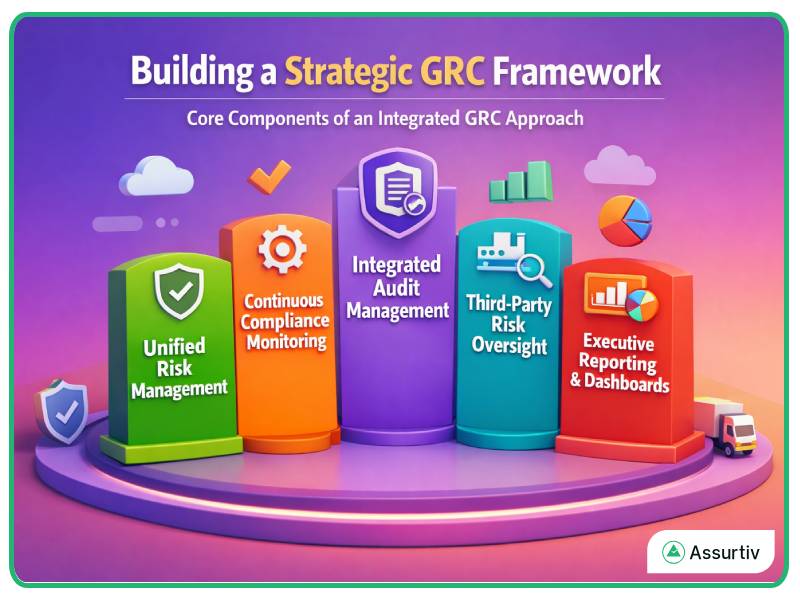
A sustainable modern GRC strategy rests on five pillars:
Unified Risk Management
A centralized risk register with consistent scoring methodology across business units.
Continuous Compliance Monitoring
Automation that tracks control performance in real time.
Integrated Audit Management
Audit findings tied directly to risk registers and remediation tracking.
Third-Party Risk Oversight
Visibility into vendor and supply chain exposure.
Executive Reporting & Dashboards
Real-time dashboards translating risk data into strategic insights.
These frequent questions eliminate redundancy and strengthen governance maturity.
GRC Best Practices for Sustainable Governance
Organizations implementing modern GRC strategies consistently apply the following GRC best practices:
- Establish a unified risk taxonomy
- Define measurable risk appetite thresholds
- Automate control testing where possible
- Implement continuous assurance models
- Standardize compliance mapping across frameworks
- Enable cross-functional reporting
These practices reduce audit fatigue and improve governance transparency.
Operationalizing an Enterprise GRC Strategy
Technology Enablement and Automation
Manual compliance processes cannot be scaled.
Modern GRC platforms provide:
- Centralized policy management
- Automated control tracking
- Real-time risk scoring
- Regulatory mapping updates
- Workflow-driven remediation tracking
Automation reduces reporting delays and strengthens data integrity.
It also enables:
- Live dashboards
- Scenario modelling
- Predictive analytics
- Continuous compliance evidence collection
Technology is not a replacement for governance — it is its accelerator.
Breaking Down Silos Across Functions
A fragmented governance structure undermines risk of visibility.
An effective enterprise GRC strategy requires:
- Shared data models
- Unified reporting standards
- Clear accountability
- Cross-functional collaboration
When governance, risk, audit, and compliance teams operate within, a common checklist of decision-making becomes faster and more consistent.
Measuring the Success of a Modern GRC Strategy
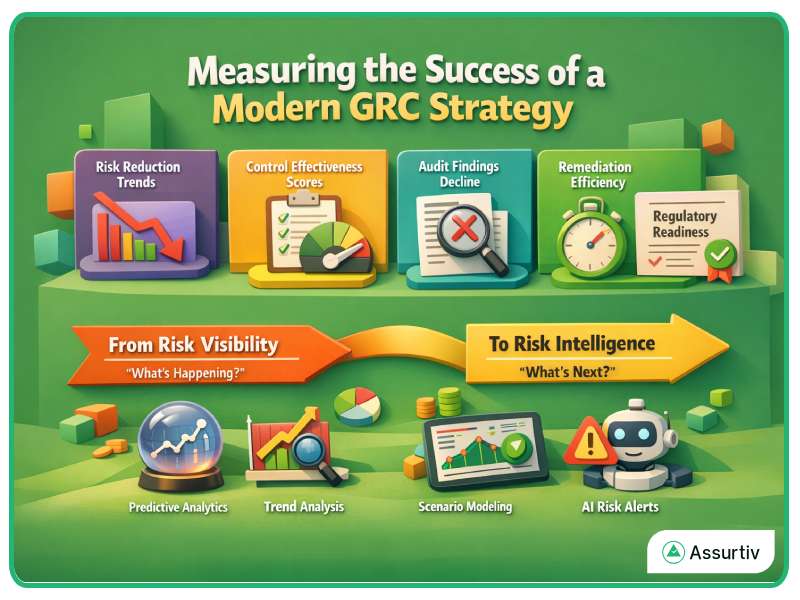
Strategies without measurement are ineffective.
Key indicators of a mature modern GRC strategy include:
Risk Reduction Trends
Demonstrable decrease in high-impact risks over time.
Control Effectiveness Scores
Improved performance of critical controls.
Audit Findings Decline
Fewer repeat and high-severity findings.
Remediation Efficiency
Reduced average time to close compliance gaps.
Regulatory Readiness
Improved audit and certification outcomes.
These metrics shift governance from static reporting to dynamic oversight.
From Risk Visibility to Risk Intelligence
Visibility answers:
“What is happening?”
Intelligence answers:
“What is likely to happen next?”
Advanced GRC programs leverage:
- Predictive analytics
- Trend analysis
- Scenario modelling
- AI-powered risk alerts
This evolution marks the transition from reactive governance to proactive leadership risk.
The Future of Integrated GRC
Governance is entering a new era defined by:
- Continuous assurance models
- Real-time compliance dashboards
- AI-driven risk insights
- ESG risk integration
- Cyber resilience monitoring
The future is not about documenting compliance.
It is about engineering resilience.
Organizations that adopt a strategic GRC framework today position themselves to adapt faster, respond smarter, and compete more confidently.
To address frequent questions around modern GRC strategy and integrated governance frameworks, here are concise answers to key decision-making concerns.
Frequently Asked Questions
What is a modern GRC strategy?
A modern GRC strategy is an integrated governance, risk, and compliance framework that aligns risk oversight with business objectives using automation and continuous monitoring. It focuses on measurable risk reduction rather than checklist-driven compliance.
How does modern GRC strategy differ from traditional compliance?
Traditional compliance focuses on passing audits and documenting controls, while a modern GRC strategy emphasizes outcome-based compliance and enterprise-wide risk visibility. It integrates risk, audit, and compliance into a unified framework.
What is outcome-based compliance in GRC?
Outcome-based compliance measures whether controls effectively reduce risk exposure instead of simply confirming their implementation. It prioritizes business impact, remediation speed, and improved control effectiveness.
What are the key components of an enterprise GRC strategy?
An enterprise GRC strategy includes centralized risk management, continuous compliance monitoring, integrated audit tracking, automated reporting, and executive dashboards. These elements create an integrated GRC approach across the organization.
Why is an integrated GRC approach important?
An integrated GRC approach eliminates silos between risk, compliance, and audit functions, improving transparency and decision-making. It enables strategic governance and strengthens long-term resilience.
Conclusion
Checkbox compliance may satisfy minimum requirements.
But it does not build resilience.
It does not strengthen decision-making.
It does not support sustainable growth.
A modern GRC strategy transforms governance from a cost center into a strategic asset.
By embracing outcome-based compliance, integrating risk functions, and leveraging automation, organizations can:
- Reduce regulatory exposure
- Strengthen operational continuity
- Improve executive confidence
- Accelerate strategic initiatives
The real question is not whether compliance is required.
The real question is whether governance is enabling progress — or merely documenting risk.
Those who choose integration, intelligence, and strategy will lead to the next era of enterprise resilience.